
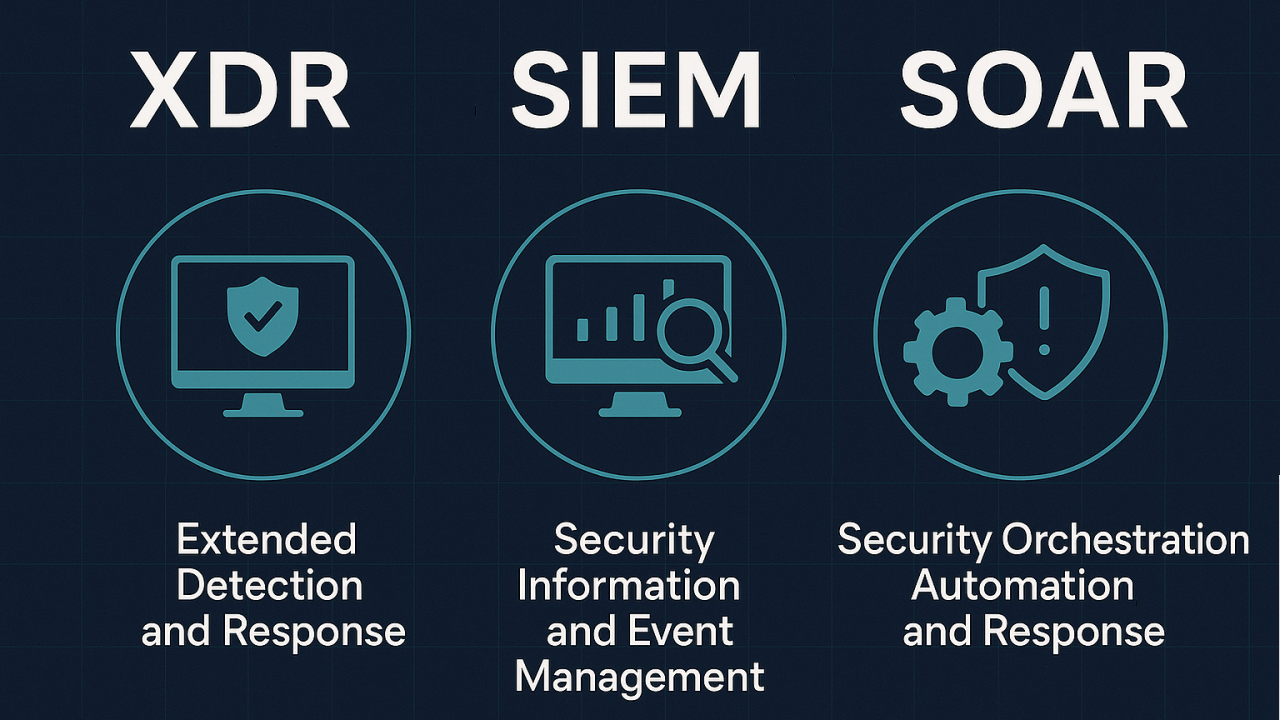
What Is SIEM vs XDR vs SOAR? Key Differences, Use Cases, and How to Choose the Right Security Solution 2026

Introduction
As cyber threats grow more advanced and persistent, organizations must adopt intelligent security operations technologies to detect, investigate, and respond to attacks efficiently. Among the most discussed solutions in modern cybersecurity are SIEM, XDR, and SOAR. While these tools often work together within a Security Operations Center (SOC), each serves a distinct purpose.
Understanding the differences between SIEM vs XDR vs SOAR is critical for IT leaders, CISOs, and security professionals looking to build a scalable, future-proof security strategy.
JOIN WHATSAPP GROUP FOR UPDATES
What Is SIEM (Security Information and Event Management)?
Security Information and Event Management (SIEM) platforms collect, aggregate, and analyze log data from across an organization’s IT infrastructure. This includes servers, firewalls, endpoints, cloud systems, and applications.
Key Functions of SIEM:
- Centralized log management
- Real-time event monitoring
- Threat detection through correlation rules
- Compliance reporting (PCI DSS, ISO 27001, HIPAA)
- Incident investigation and forensics
SIEM provides broad visibility across environments, making it a foundational technology for many SOC teams. However, traditional SIEM tools often generate large volumes of alerts, requiring skilled analysts to triage and investigate incidents.
Best for: Organizations needing compliance reporting and centralized visibility.
What Is XDR (Extended Detection and Response)?
Extended Detection and Response (XDR) is a more modern, integrated security solution that correlates telemetry from multiple security layers including endpoints, networks, cloud workloads, identity systems, and email platforms.
Unlike traditional SIEM, XDR is designed to improve detection accuracy and reduce alert fatigue by using built-in analytics and behavioral detection.
Key Functions of XDR:
- Cross-layer threat correlation
- Advanced behavioral analytics
- Automated investigation capabilities
- Faster threat detection
- Reduced false positives
XDR solutions are particularly effective at detecting complex, multi-stage attacks that move laterally across systems.
Best for: Organizations seeking stronger threat detection with less manual analysis.
What Is SOAR (Security Orchestration, Automation, and Response)?
Security Orchestration, Automation, and Response (SOAR) platforms focus on improving operational efficiency. Rather than primarily detecting threats, SOAR automates repetitive security tasks and orchestrates response workflows across integrated tools.
Key Functions of SOAR:
- Automated incident response playbooks
- Workflow orchestration
- Case management
- Threat intelligence integration
- Alert enrichment and automated containment
For example, when a phishing alert is triggered, SOAR can automatically isolate the endpoint, disable a compromised account, and notify stakeholders without manual intervention.
Best for: Security teams looking to reduce response time and increase automation.
SIEM vs XDR vs SOAR: How They Work Together
While SIEM, XDR, and SOAR serve different purposes, they are complementary technologies:
- SIEM provides centralized visibility and compliance reporting.
- XDR enhances detection by correlating security telemetry across systems.
- SOAR automates incident response and streamlines operations.
In mature security environments, SIEM ingests logs, XDR improves detection quality, and SOAR executes automated response workflows. Together, they create a comprehensive security operations ecosystem that reduces dwell time and improves resilience.
How to Choose the Right Approach
Selecting between SIEM, XDR, and SOAR depends on your organization’s security maturity and resources:
- Small teams or early-stage security programs may begin with SIEM for visibility and compliance.
- Organizations facing advanced threats may benefit from XDR to improve detection accuracy.
- Large enterprises or mature SOCs often deploy all three technologies for full visibility, detection, and automation.
When evaluating solutions, consider:
- Budget and operational capacity
- Regulatory requirements
- Cloud and hybrid infrastructure
- Incident response maturity
A phased approach is often most practical, starting with visibility (SIEM), enhancing detection (XDR), and scaling automation (SOAR).
JOIN WHATSAPP GROUP FOR UPDATES
ALSO READ
- Zero Trust Security Explained: A Complete Business Guide for 2026
- Best Password Managers for Businesses in 2026-Enterprise Security Comparison
- Top Cybersecurity Threats for Businesses in 2026
Conclusion
Understanding the differences between SIEM vs XDR vs SOAR empowers organizations to design stronger cybersecurity programs. SIEM centralizes visibility, XDR enhances detection capabilities, and SOAR accelerates response. When strategically combined, these technologies form the backbone of modern security operations.
Disclaimer
The information on SecurityInsightsPro.com is provided for educational and informational purposes only and should not be considered professional cybersecurity, legal, or technical advice. Always consult qualified professionals before implementing security measures. The site and its authors are not responsible for any actions taken based on this content.